P131.1 Current Prediction
(as of 2002 08 08
11:24 AM EDT)
The following prediction is result of astrometric measurements made by Mike Person on two FASTT frames supplied by Ron Stone. The offset is relative to the star's published position, as determined by McDonald and Elliot (2000)*. The Pluto offsets to its ephemeris were estimated from Pluto's recent occultation with P126 in July 2002. Results for Pluto are tabulated as offsets from the unmodified light-time corrected, geocentric JPL Horizon's ephemeris (PLU006 and DE-0406, LE-0406).
| Reference Position (2.0)* | RA (J2000) | Dec (J2000) | R Mag* |
| P131.1 | 16 58 49.456 | -12 51 31.41 | 15.65 |
|
Offsets from Reference
|
|||
| Body | RA (arcsec) | Dec (arcsec) | |
| P131.1 | – 0.374+/– 0.009 | – 0.460+/– 0.007 | |
| Pluto | – 0.02 +/– 0.007 | – 0.023 +/– 0.007 | |
* AJ 120, 1599
|
P131.1 Current Prediction (as of 2002 08 08 11:24 AM EDT) |
| Date and Time (yyyy mm dd hh:mm:ss) | 2002 08 21 07:00:13 UT |
| Minimum Geocentric Separation (arcsec) | 0.06 +/- 0.01 |
| Position Angle (degrees) | 117 |
| Geocentric Shadow Velocity (km s-1) | 6.6 |
| Star Magnitude | 15.7 (V) |
| Solar Angle (deg) | 107 |
| East Longitude (deg) | -179 |
| Distance (AU) | 30.24 |
| Prediction Version | p131.1-2.5 |
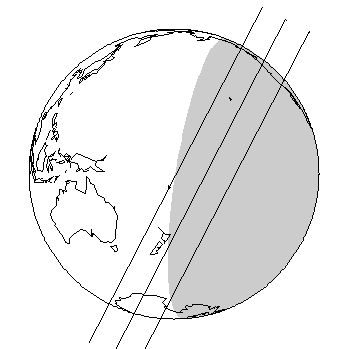
Note: On map, the gray area is where the sun is more than 12 degrees below the horizon. The position angle is the angle (measured north through east) of the occulting body relative to the star at closest approach. Position angle is derived from the prediction notebook results and is useful for plotting the globes.
Prediction Notes
Archive of past P131.1 occultation predictions.
Pluto Occultation Predictions for Individual Sites
| Site | East Longitude | Latitude | Distance* (km) | Immersion (UT) |
Mid-time (UT) |
Emersion (UT) |
Altitude P131.1 (Degrees) |
| Anderson Mesa | -111 32 12 | 35 05 48 | 1051 | 06:44:31 | 06:45:45 | 06:46:59 | 12 |
| Dominion Observatory, Canada | -123 25 00 | 48 31 12 | 683 | 06:42:53 | 06:44:53 | 06:47:13 | 13 |
| Geocentric | 1254 | 07:00:13 | |||||
| Guillermo Haro, Mexico | -110 23 00 | 31 03 12 | 1461 | 06:46:13 | 13 | ||
| Haleakala | -156 15 24 | 20 42 24 | 931 | 06:48:36 | 06:50:18 | 06:52:00 | 50 |
| Lick | -121 38 12 | 37 20 36 | 371 | 06:42:57 | 06:45:41 | 06:48:26 | 18 |
| Lowell | -111 39 54 | 35 12 12 | 1036 | 06:44:26 | 06:45:45 | 06:47:03 | 12 |
| Mauna Kea (IRTF) | -155 28 29 | 19 49 46 | 810 | 06:48:21 | 06:50:23 | 06:52:25 | 51 |
| Mt Lemmon | -110 47 30 | 32 26 30 | 1321 | 06:46:03 | 13 | ||
| Palomar | -116 51 54 | 33 21 24 | 958 | 06:44:22 |
06:46:01 |
06:47:39 | 17 |
| San Felipe, Mexico | -115 27 54 | 31 02 36 | 1227 | 06:46:16 | 17 | ||
| Tonantzintla, Mexico | -98 18 54 | 19 02 00 | 2919 | 06:48:14 | 6 | ||
| WIRO | -105 58 36 | 41 05 54 | 703 | 06:42:51 | 06:45:10 | 06:47:30 | 6 |
* distance from the center of Pluto's path across the Earth. Any site beyond 1160 km (the half-light radius of the shadow) is considered to be outside the shadow. The error in the distance from the center is several hundred kilometers for this prediction, so some sites presently tabulated as outside the shadow may be within it and vice versa. The times may be in error by several minutes, so data recording should commence about 5 minutes prior to the predicted immersion time and end several minutes after the emersion time. Sites predicted to be outside the shadow should record data for 10-15 minutes, centered at the mid-time.
Please direct all inquiries to Planetary Astronomy Lab (planetary-astronomy@mit.edu)
Last updated by Katie Carbonari (kcarbon@mit.edu) 2002 08 12 10:47 PM EDT